









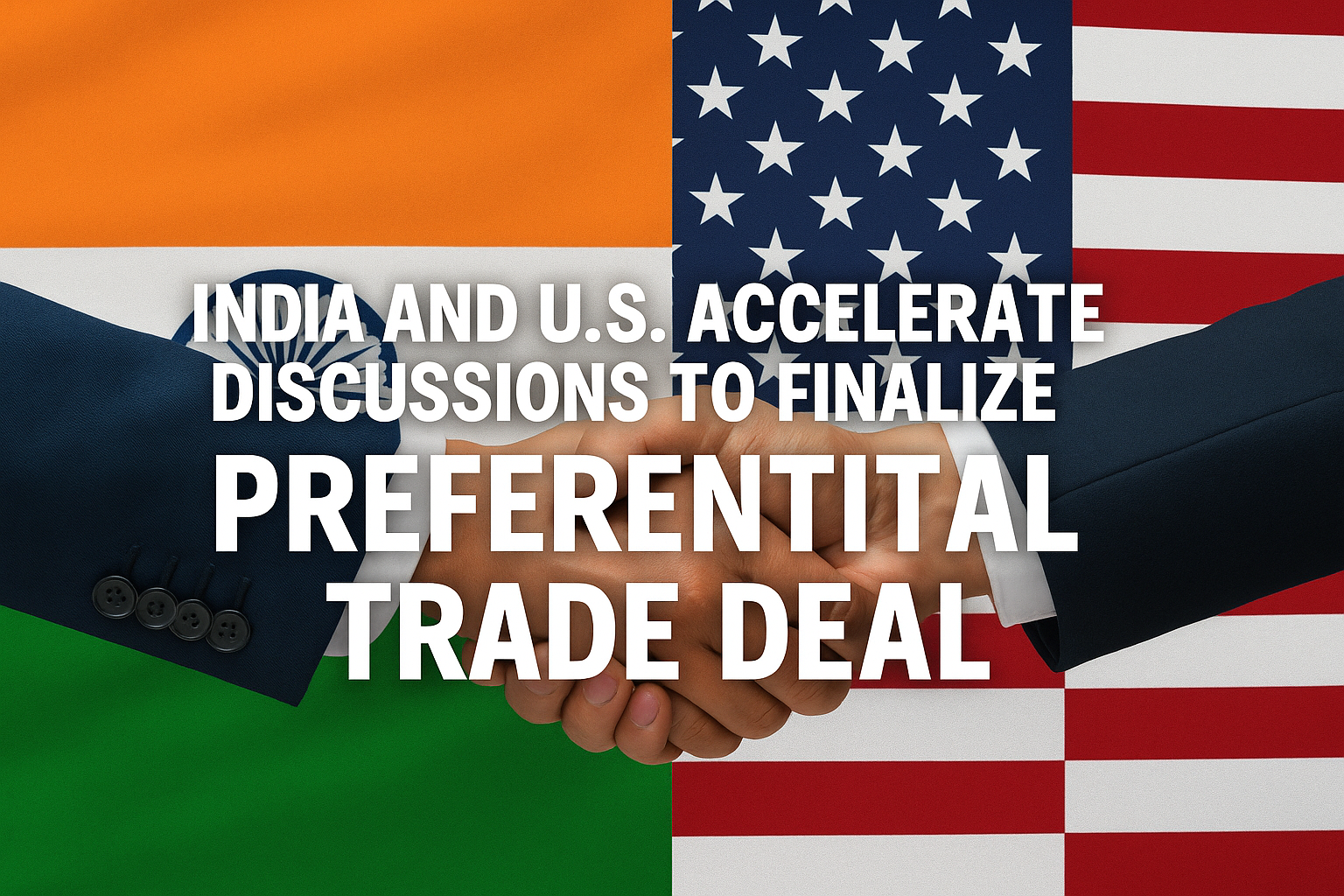
India and the United States are accelerating discussions to finalize a major bilateral trade agreement aimed at granting preferential market access for businesses in both countries. This effort marks a strategic turning point in Indo-U.S. economic relations, potentially ushering in a new era of cooperation, increased trade volume, and mutual investment opportunities.
With both nations seeking to fortify their economic positions amid global volatility, this deal is not just a diplomatic milestone—it is a critical move to align the world’s largest and fastest-growing democracies for long-term economic synergy.
Background: A Dynamic Trade Partnership
The India–U.S. economic relationship has seen consistent growth over the last decade, evolving from a transactional exchange of goods into a complex partnership spanning defense, technology, services, and manufacturing.
India is the United States’ ninth-largest trading partner, while the U.S. remains India’s top trading ally. Bilateral trade between the two nations crossed $129 billion in 2024, and both sides are now targeting the $500 billion mark by the end of the decade.
However, the journey has not been without friction. Over the years, trade disagreements have emerged, particularly concerning tariff structures, intellectual property rights, data localization, and agricultural subsidies. The current push for a formal trade agreement aims to resolve many of these issues and establish a stable, mutually beneficial framework.
Current Negotiation Status
India’s Commerce Ministry confirmed that both countries have deployed dedicated negotiation teams to fast-track the trade deal. After months of behind-the-scenes work, discussions are now gaining momentum, with a framework for preferential market access shaping up.
Preferential market access means selected goods and services from both countries will enjoy reduced tariffs or even duty-free entry, enhancing competitiveness and reducing costs for consumers and businesses alike.
The recent announcement of a temporary 90-day pause on proposed U.S. tariff hikes—including a 26% duty on Indian imports—has added urgency to the talks. This window offers both governments the opportunity to lock in terms before punitive measures take effect.
The emerging deal is expected to begin with a limited-scope agreement focusing on immediate market access while laying the groundwork for a broader and more comprehensive bilateral trade agreement.
Strategic Objectives of the Trade Pact
The proposed deal is designed around several core goals that reflect the economic priorities of both nations:
1. Improved Market Access
The primary goal is to ease entry barriers for goods and services across multiple industries. India is seeking broader access to the U.S. for textiles, pharmaceuticals, IT services, and agricultural produce. In return, the U.S. aims to secure openings for its manufacturing goods, agricultural products, and medical devices in India.
2. Tariff Harmonization
India has signaled its willingness to reduce or eliminate duties on several U.S. products, particularly in the agri-business and tech sectors. In turn, the U.S. is expected to ease restrictions on Indian exports such as automotive components, seafood, and textiles.
Such tariff adjustments could make exports more competitive and encourage cross-border investment.
3. Trade in Services and Tech
India has long pushed for smoother movement of skilled professionals, particularly under H-1B and L-1 visa categories. While immigration policies remain politically sensitive in the U.S., negotiators are expected to find middle ground to facilitate tech-driven collaboration.
Additionally, enhanced cooperation in sectors such as artificial intelligence, semiconductors, and digital payments is being discussed under the broader umbrella of this trade agreement.
4. Supply Chain Diversification
With global supply chains undergoing realignment post-COVID and due to geopolitical tensions with China, both India and the U.S. are looking to strengthen bilateral production and logistics networks. The trade deal will support India’s role as a key node in global manufacturing, particularly in electronics, pharmaceuticals, and clean energy.
Economic Implications for India
A finalized trade deal with the U.S. would provide a substantial boost to India’s exports, particularly in sectors like textiles, IT services, engineering goods, and pharmaceuticals. It would also encourage more Foreign Direct Investment (FDI), as predictability in trade policy is a major factor for global investors.
Moreover, by aligning standards and reducing trade frictions, Indian exporters could become more competitive in one of the world’s largest markets. The deal is expected to energize key sectors of the Indian economy, help small and medium enterprises (SMEs) scale globally, and contribute to job creation.
India’s broader ambition of becoming a $5 trillion economy by 2030 heavily depends on export-led growth. This agreement could play a pivotal role in realizing that vision.
Potential Benefits for the U.S.
For the United States, the agreement opens new avenues to tap into the vast and growing Indian consumer base. U.S. businesses in agriculture, aerospace, defense, and healthcare could see expanded opportunities.
Additionally, deeper trade ties with India serve Washington’s strategic interest of diversifying away from overdependence on China and securing stable supply chains in the Indo-Pacific region.
The deal may also serve as a cornerstone for larger Indo-Pacific economic cooperation frameworks, reinforcing U.S. influence in Asia while advancing democratic economic norms.
Challenges and Roadblocks
While the momentum is positive, several unresolved issues could pose obstacles:
• Immigration & Work Visas
India continues to press for easing restrictions on temporary skilled labor migration, particularly for tech workers. However, U.S. domestic policy considerations—especially in an election year—may limit flexibility in this area.
• Intellectual Property & Digital Trade
Differences persist regarding data privacy regulations, e-commerce taxation, and cross-border data flows. India prefers localized data storage in many sectors, while the U.S. promotes open digital markets.
• Agricultural Subsidies and SPS Norms
Sanitary and phytosanitary standards (SPS) remain contentious, especially when it comes to American agri exports like poultry and dairy. India seeks protection for its farmers, while the U.S. expects compliance with its high food safety benchmarks.
• Steel and Aluminum Tariffs
Recently, the U.S. has reimposed tariffs on steel and aluminum imports under national security clauses, impacting Indian producers. India may use the trade talks as leverage to seek relief or exemptions.
Interim Deal Before Full-Scale Agreement
Officials from both countries have hinted at the possibility of signing an interim “early harvest” deal. This would include agreed-upon tariff cuts and market access terms, deferring more complex issues such as immigration, digital regulation, and environmental standards for future negotiation.
This two-phased approach could help both countries declare progress while giving negotiators more time to build consensus on tougher subjects.
Industry Reaction
Indian industry associations have widely welcomed the progress in trade talks. Exporters from sectors such as apparel, pharmaceuticals, and machinery believe the agreement will improve global competitiveness and unlock access to new supply chains.
Meanwhile, U.S. businesses see India as a high-growth market with enormous potential, particularly for medical technology, clean energy, logistics, and agricultural exports.
Investors are watching developments closely. A finalized agreement could lead to a re-rating of India’s risk profile and encourage greater institutional investment into both public markets and private enterprises.
Conclusion: A Defining Moment in Indo–U.S. Trade Relations
The ongoing India–U.S. trade negotiations have the potential to shape not only bilateral relations but also influence global trade dynamics. As both nations navigate complex political and economic realities, the convergence of their interests represents a rare alignment of strategic goals and commercial opportunities.
If successful, this trade deal will stand as a testament to economic diplomacy, demonstrating that even in a fragmented global landscape, pragmatic cooperation can deliver shared prosperity.
For businesses, investors, and policymakers on both sides, this is more than just another trade agreement—it is a blueprint for the future of trans-Pacific commerce.