








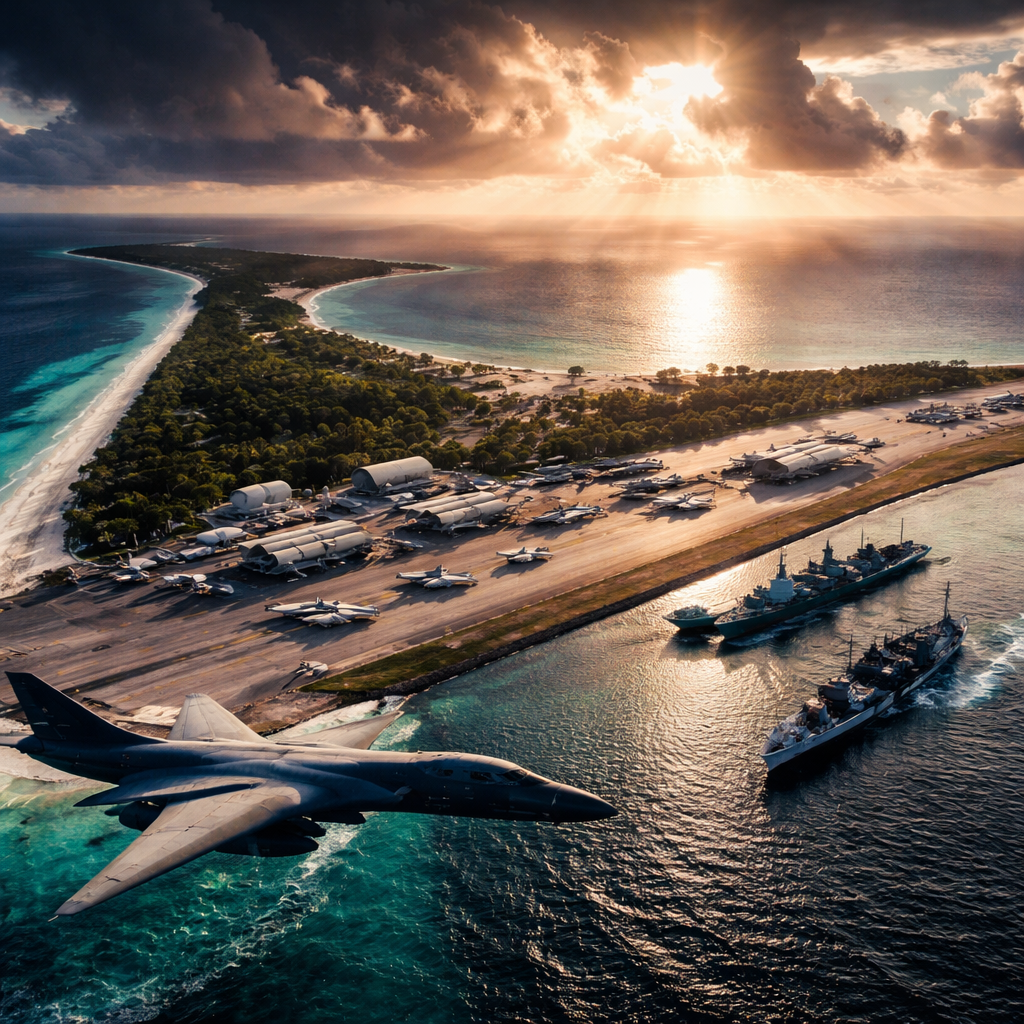
The remote island of Diego Garcia has once again emerged at the center of global attention, as rising geopolitical tensions, military developments, and sovereignty disputes converge in the Indian Ocean.
In recent days, the island—home to a critical joint U.S.-U.K. military base—has been thrust into the spotlight following reports of missile-related tensions linked to broader regional conflicts. At the same time, long-standing political and legal debates over the future of the Chagos Archipelago continue to shape its uncertain trajectory.
Strategic Importance of Diego Garcia
Diego Garcia is widely regarded as one of the most strategically important military bases in the world. Situated in the central Indian Ocean, it serves as a key logistical and operational hub for Western military forces.
Its geographic location allows rapid deployment of air and naval assets across multiple regions, including:
- The Middle East
- East Africa
- South Asia
- The Indo-Pacific
This positioning enables military forces to project power both westward toward volatile regions and eastward toward Asia-Pacific theaters. Over the decades, the base has supported numerous operations, making it an essential pillar of global military strategy.
A Hub for Modern Military Operations
The base on Diego Garcia plays a vital role in modern warfare and defense planning. It is equipped to support long-range bombers, naval fleets, and surveillance systems.
Key capabilities include:
- Strategic air operations
- Maritime surveillance
- Intelligence gathering
- Rapid-response deployment
Its infrastructure allows for sustained military operations far from mainland bases, providing a unique advantage in times of crisis. As geopolitical tensions rise globally, such forward-operating bases are becoming increasingly critical.
Rising Geopolitical Tensions
The island has recently gained renewed attention due to heightened tensions in the broader region. Military analysts note that the increasing range and sophistication of modern missile systems have brought even remote installations like Diego Garcia into potential threat zones.
This shift reflects a changing global security landscape, where technological advancements have reduced the protective advantage once offered by geographic isolation.
The situation underscores the evolving nature of warfare, where strategic assets are no longer confined to traditional battlefields but are part of a wider global network of influence and deterrence.
The Chagos Islands Dispute
Beyond its military significance, Diego Garcia is deeply tied to a long-standing sovereignty dispute involving the United Kingdom and Mauritius.
The Chagos Archipelago was separated from Mauritius during the colonial period, and control of the islands has been contested ever since. In recent years, international legal bodies have weighed in, supporting Mauritius’s claim to sovereignty.
A major development came with an agreement aimed at transferring sovereignty of the Chagos Islands to Mauritius while allowing continued operation of the military base through a long-term lease arrangement.
This agreement represents a complex compromise, balancing legal obligations with strategic military interests.
Political Debate and Global Reactions
The future of Diego Garcia has sparked significant debate on the global stage. Governments, policymakers, and analysts continue to weigh the implications of recent agreements and shifting geopolitical dynamics.
Key concerns include:
- Maintaining long-term military access
- Ensuring regional stability
- Addressing international legal rulings
- Managing strategic competition in the Indo-Pacific
The issue has also drawn attention from political leaders and defense experts, highlighting its importance beyond regional boundaries.
The Chagossian Community: A Human Story
One of the most sensitive aspects of the Diego Garcia issue is the displacement of the Chagossian people. In the late 1960s and early 1970s, residents were removed from the islands to facilitate the construction of the military base.
Since then, the Chagossians have fought for their right to return, making their struggle a central element of the broader debate.
Recent developments have seen renewed efforts by members of the community to re-establish a presence on parts of the archipelago. Their actions have reignited discussions around:
- Historical justice
- Human rights
- The right of return
This human dimension adds complexity to an already intricate geopolitical issue.
Diego Garcia and the Indo-Pacific Strategy
The significance of Diego Garcia extends beyond immediate regional concerns. It plays a crucial role in the broader Indo-Pacific strategy, a region that has become central to global economic and military competition.
The Indian Ocean serves as a major corridor for international trade, including energy shipments. Control over strategic locations in this region enhances a nation’s ability to influence global supply chains and security dynamics.
As major powers increasingly focus on the Indo-Pacific, Diego Garcia’s importance is expected to grow further.
Security Challenges and Risks
Despite its strategic advantages, Diego Garcia faces several ongoing challenges:
1. Emerging Military Threats
Advancements in missile technology and long-range capabilities have increased the vulnerability of remote bases.
2. Geopolitical Rivalries
Competition among global powers is intensifying, particularly in the Indo-Pacific region.
3. Legal and Sovereignty Issues
The unresolved status of the Chagos Archipelago continues to create uncertainty.
4. Human Rights Concerns
The displacement of the Chagossian population remains a critical issue in international discussions.
Future Outlook
The future of Diego Garcia will likely be shaped by a combination of geopolitical, legal, and social factors.
Key developments to watch include:
- Implementation of sovereignty agreements
- Evolution of global military strategies
- Shifts in regional power dynamics
- Progress on addressing the rights of displaced communities
In the short term, the island will remain a vital military asset. However, its long-term status will depend on how these complex factors evolve.
Conclusion: A Small Island with Global Impact
Diego Garcia may be geographically isolated, but its influence on global affairs is substantial. It stands at the intersection of military strategy, international law, and historical justice.
As geopolitical tensions continue to rise and the Indo-Pacific gains prominence, the island’s role is likely to become even more significant.
From its strategic military value to the ongoing debates surrounding sovereignty and human rights, Diego Garcia remains a powerful symbol of how a small piece of land can shape global narratives.
In an increasingly interconnected and competitive world, the story of Diego Garcia is far from over—it is, in many ways, just entering a new and defining chapter