Comet Sightings Shock Scientists — Latest News Update 2026
Introduction
In a stunning latest news update 2026, astronomers across the globe are closely tracking a newly discovered comet that has rapidly gained attention for its unusual brightness and trajectory. First spotted by observatories earlier this month, the celestial object is now visible from several parts of Earth, sparking excitement among scientists and skywatchers alike.
This breaking update is significant not only for space enthusiasts but also for ongoing research into the origins of our solar system. The comet’s unexpected behavior is raising new questions—and possibly rewriting existing theories.
What Happened (Main Event)
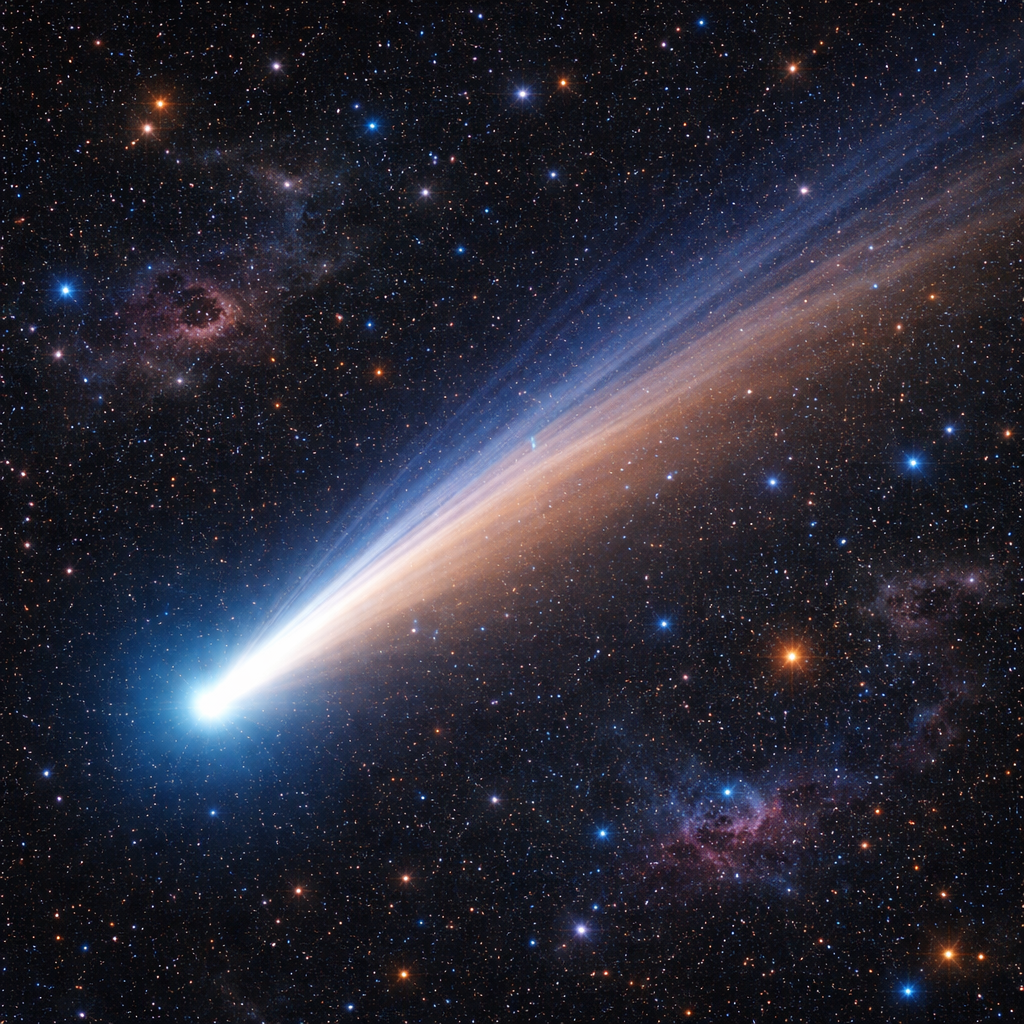
The comet, provisionally named “C/2026 A1,” was detected by automated sky surveys scanning deep space for near-Earth objects. Within days of its discovery, astronomers confirmed that the comet was moving at an unusually high speed and had developed a bright, extended tail.
Timeline of Events
- Early March 2026: Initial detection by space observatories
- Within 48 hours: Confirmed as a long-period comet
- Mid-March 2026: Rapid increase in brightness observed
- Current: Visible through telescopes and, in some regions, the naked eye
Scientists noted that the comet’s orbit suggests it originated from the distant Oort Cloud, a region filled with icy bodies at the edge of our solar system.
Key Highlights
- The comet is one of the brightest objects observed in recent years
- It is traveling at an exceptionally high velocity
- Visible in parts of Asia and Europe during early morning hours
- Exhibits a rare double-tail structure
- Being tracked continuously for trajectory changes
Background Information
Comets are icy remnants from the formation of the solar system, often described as “cosmic time capsules.” When they approach the Sun, heat causes them to release gas and dust, forming a glowing coma and tail.
Historically, comets have played a crucial role in scientific discovery. Famous examples like Halley’s Comet have helped researchers understand orbital mechanics and the composition of early planetary materials.
What makes this latest news update 2026 particularly interesting is how quickly this comet has evolved—from a faint object to a prominent feature in the night sky within days.
Expert Opinions / Reactions
Astronomers worldwide are calling this event “extraordinary.”
Experts suggest that the comet’s rapid brightening may indicate a higher concentration of volatile materials, such as frozen gases, which vaporize quickly when exposed to solar radiation.
Some researchers believe the object could provide new insights into the early solar system, while others are focused on analyzing its unusual tail formation.
“This is a rare opportunity,” one expert noted. “We are witnessing a comet that behaves differently from what we typically expect.”
Impact & Consequences
The appearance of this comet has several implications:
Scientific Impact
- Offers a chance to study primitive solar system material
- May refine models of comet formation and behavior
Public Interest
- Increased engagement in astronomy and space observation
- Surge in telescope sales and skywatching activities
Technological Advancements
- Encourages improved tracking systems for near-Earth objects
- Enhances collaboration between global space agencies
This breaking update is also a reminder of how dynamic and unpredictable our universe can be.
Latest Updates / Developments
In the most recent latest developments, astronomers have reported fluctuations in the comet’s brightness, suggesting ongoing internal activity. Observatories are now using advanced imaging tools to capture high-resolution data.
Additionally, space agencies are considering whether existing satellites can be redirected to gather closer observations. While no mission has been officially announced, discussions are ongoing.
Skywatching guides have also been released, helping the public locate the comet during optimal viewing times.
What Happens Next
Looking ahead, scientists will continue to monitor the comet’s path as it approaches its closest point to the Sun. This phase is expected to be the most dramatic, with potential increases in brightness and tail length.
There is also a possibility that the comet could fragment, a phenomenon seen in previous celestial events. If this occurs, it would provide even more valuable data for researchers.
The latest news update 2026 suggests that the coming weeks will be critical for observation and analysis.
Conclusion
The sudden emergence of this comet has captivated both the scientific community and the public, making it one of the most talked-about space events of the year. From its mysterious origins to its striking visibility, the comet represents a rare cosmic spectacle.
As this latest news update 2026 continues to unfold, one thing is clear: our universe still holds many surprises. Whether you’re a scientist or a casual observer, this is a moment worth watching—literally and figuratively.