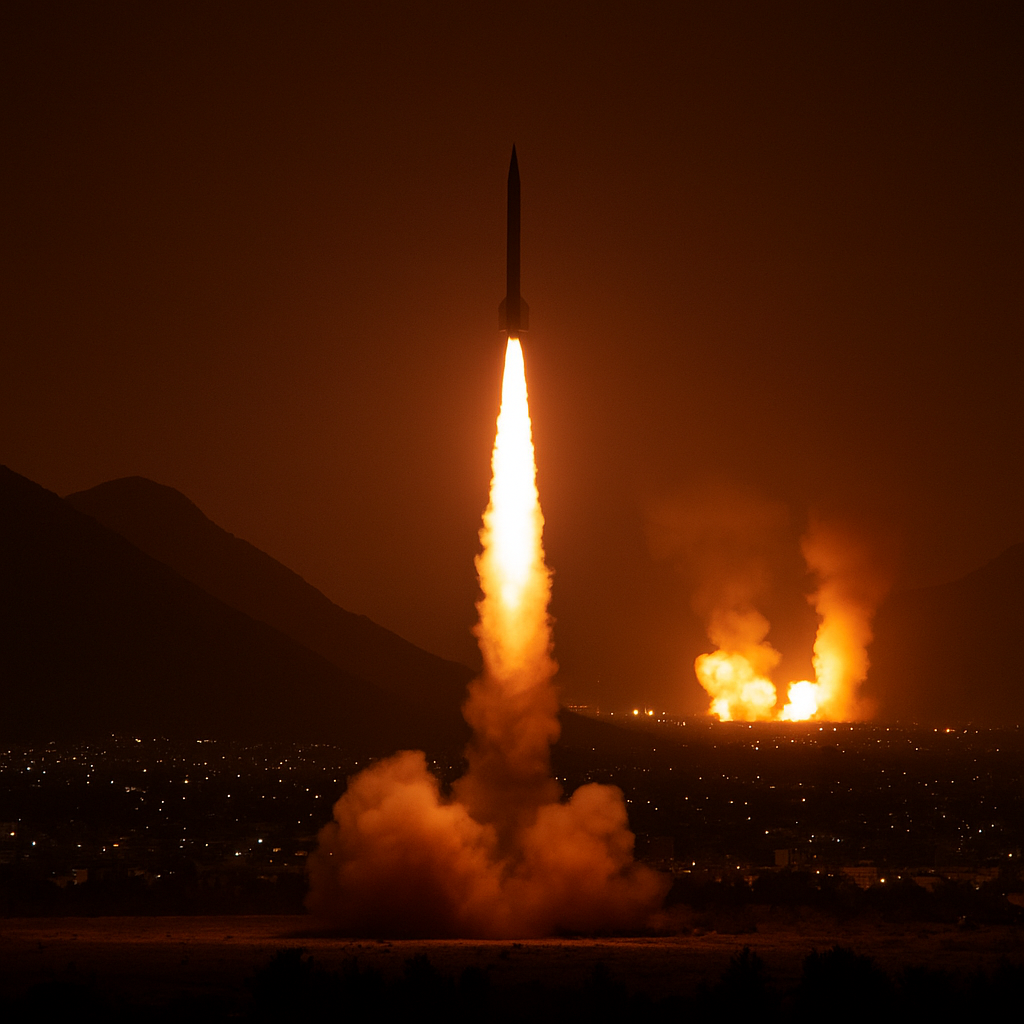
In the early hours of June 13, 2025, Israel launched a series of unprecedented military strikes deep into Iranian territory, targeting nuclear facilities, ballistic missile factories, military infrastructure, and senior Iranian commanders. This marked the most significant direct Israeli attack on Iran in decades, heralding a dramatic escalation in a long-simmering regional confrontation. Codenamed “Operation Rising Lion,” the assault constituted a coordinated air and covert campaign designed to decisively degrade Iran’s nuclear and missile capabilities and reshape the strategic balance in the Middle East.
The Attack Unfolds
Shortly after 3 a.m. local time, explosions were reported across multiple Iranian cities as Israel’s Air Force deployed more than 200 fighter jets and precision-guided munitions. Israeli forces struck over 100 pre-identified military targets, including uranium enrichment sites in Natanz, Arak, and Isfahan; ballistic missile production facilities; IRGC command compounds; and radar systems that support air defense.
Iranian officials confirmed that key military installations and nuclear infrastructure had been damaged. Unverified reports indicated casualties among senior members of the Islamic Revolutionary Guard Corps, including high-ranking officials involved in Iran’s nuclear development and missile defense programs.
The strikes were highly coordinated, using air-to-ground missiles, drones, and long-range standoff weapons. Israel’s military intelligence apparatus had reportedly spent months collecting data, with operations on the ground aiding in laser-designation and real-time feedback.
Strategic Rationale
Israel justified the attack as a necessary preemptive action against an imminent existential threat. The Israeli leadership stated that Iran’s nuclear program had reached a red line, with uranium enrichment reportedly nearing weapons-grade levels and missile deployment capabilities expanding.
Israel’s national security cabinet authorized the operation after intelligence indicated Iran was preparing to activate advanced centrifuges in hidden facilities not declared to international inspectors. Officials stressed that diplomatic avenues had been exhausted and that military action was the only remaining option to safeguard national security.
For decades, Israel has maintained a policy of ambiguity and targeted assassinations to thwart Iran’s nuclear ambitions. However, Operation Rising Lion marks a shift from shadow war tactics to overt, large-scale military engagement.
Iran’s Response and Regional Fallout
Iranian leaders condemned the strikes as an act of war, vowing swift and “unforgettable” retaliation. Within hours, Iran launched over 100 drones and several ballistic missiles targeting Israeli military installations and civilian centers. Most were intercepted by Israel’s advanced Iron Dome and Arrow defense systems, but a few minor damages and injuries were reported in southern regions.
Regional tensions escalated rapidly. Iraq and Jordan closed their airspace temporarily, and Lebanon placed its military on high alert. Hezbollah, Iran’s proxy in Lebanon, issued statements of solidarity with Iran, hinting at possible coordinated actions from other Axis of Resistance members, including factions in Syria, Yemen, and Gaza.
Back in Iran, protests broke out in Tehran and Isfahan, both in support of retaliation and against the government’s handling of the nuclear program. Iranian state media went into high alert mode, broadcasting images of damaged sites and military funerals, seeking to unify public sentiment around national defense.
International Reactions
World leaders reacted with a mix of alarm and calls for restraint. The United States reiterated that it was not involved in the Israeli strikes and called for de-escalation. European leaders, while acknowledging Israel’s security concerns, emphasized the importance of returning to diplomatic channels and preserving regional peace.
China and Russia, both having closer ties with Tehran, condemned the Israeli strikes and demanded an emergency session of the United Nations Security Council. Meanwhile, Gulf nations like Saudi Arabia and the UAE expressed concern over the potential spillover into their territories and critical oil infrastructure.
Oil prices surged by over 6% in the aftermath of the strikes, as traders feared a disruption in supply routes through the Strait of Hormuz. Global stock markets dipped slightly, with heightened volatility expected in the coming days depending on how Iran chooses to retaliate.
Impact on Iran’s Nuclear Program
Preliminary assessments suggest that the Israeli strikes caused significant damage to centrifuge facilities and missile development labs. However, due to the dispersal and deep-buried nature of Iran’s nuclear infrastructure, many experts believe the program was disrupted but not destroyed.
Iran has invested in hardening its facilities against potential airstrikes, with underground bunkers, air defense systems, and decentralized operations. This redundancy allows it to recover from even severe attacks. Nonetheless, the loss of scientific personnel and high-level military coordinators is likely to slow progress in the short term.
Iran had recently unveiled new ballistic missile systems with extended range and advanced guidance capabilities, posing a strategic threat not only to Israel but also to U.S. military bases in the region. It remains unclear whether these capabilities were neutralized in the strikes.
Prospects of Retaliation
All signs point to a serious retaliatory response from Iran. Military analysts anticipate a range of possibilities:
-
Direct missile and drone attacks on Israeli territory
-
Cyberattacks targeting Israeli infrastructure
-
Terror attacks via proxies across Lebanon, Iraq, and the Gulf
-
Naval disruptions in the Strait of Hormuz
-
Assassinations or sabotage operations abroad
Iran’s Revolutionary Guard issued statements indicating readiness for asymmetric warfare, with capabilities to wage both direct and proxy conflict. The expectation is not of a one-off retaliatory strike but of a sustained campaign of pressure.
The risk of wider conflict looms large. A miscalculated move by either side could drag the region into a prolonged confrontation, potentially drawing in the United States, Gulf states, and Russia.
Domestic Fallout in Israel
Israel’s home front went into full emergency preparedness. Schools and public gatherings were suspended, and reservists were called up for duty. Hospitals were placed on high alert. The Israeli government advised citizens to stock up on essentials and prepare for extended periods of alert.
Despite opposition criticism of escalating tensions, polls indicate broad public support for the operation. Many Israelis view the strike as a necessary, albeit dangerous, step to prevent nuclear catastrophe.
Prime Minister Netanyahu addressed the nation, stating that the operation was a defensive imperative and that Israel remained open to diplomatic solutions provided Iran halted its nuclear program entirely.
Implications for the United States
The United States finds itself in a precarious position. As Israel’s closest ally, it faces pressure to support its security partner, yet the Biden administration has pursued a policy of regional de-escalation and renewed diplomacy with Iran.
The strikes threaten to unravel months of backchannel negotiations in Oman, where U.S. and Iranian officials had reportedly been exploring limited nuclear cooperation frameworks.
Washington has moved military assets into the region as a deterrent but is treading carefully to avoid being seen as complicit or being dragged into another Middle Eastern conflict.
Global Security and Energy Markets
Beyond the immediate region, global repercussions are already being felt. The escalation threatens to destabilize critical oil supply chains. Any disruption in the Strait of Hormuz—a narrow waterway through which one-third of global oil shipments pass—could drive prices sky-high and impact inflation and energy security across the world.
Intelligence agencies in Europe and Asia have increased alert levels, fearing terrorist reprisals or cyberattacks on critical infrastructure. Airlines have rerouted flights away from Iranian and Israeli airspace.
The conflict also casts a shadow on global non-proliferation efforts. The failure of diplomatic mechanisms to prevent military action may embolden other nations to pursue nuclear programs under the radar.
The Geopolitical Chessboard
The Israel-Iran confrontation is as much about regional dominance as it is about nuclear threats. Israel has signaled it will not tolerate a nuclear-armed Iran, even if that means risking war. Iran, for its part, is unlikely to back down without exacting a heavy price.
This clash redefines the balance of power in the Middle East. It may push Arab nations to reassess their security alignments. Some may seek closer ties with Israel to counterbalance Iran, while others could pursue their own independent deterrent strategies.
Turkey, Egypt, and Saudi Arabia—all regional powers—are watching closely. The outcome of this conflict could influence their defense postures and foreign policies for years to come.
Possible Scenarios Ahead
As events unfold, several possible scenarios are emerging:
-
Escalation into full-scale war: If Iran’s retaliation is massive, Israel could respond with greater force, leading to regional war.
-
Controlled confrontation: Limited tit-for-tat actions could continue without spiraling into a broader conflict.
-
Proxy warfare expansion: Iran may rely on non-state actors to keep the conflict simmering over time.
-
Renewed diplomacy: International actors may pressure both countries to return to the negotiating table under new terms.
-
Cyberwarfare theater: Increasingly, both nations may lean on cyber means to inflict damage without provoking conventional retaliation.
Conclusion
The June 13 airstrikes mark a watershed moment in Middle Eastern geopolitics. Israel’s decision to act openly and forcefully has redrawn the rules of engagement. Iran’s next move will determine whether this crisis spirals into regional war or retreats into tense stalemate.
Regardless of the path forward, one thing is clear: the era of ambiguity and indirect conflict between Israel and Iran has ended. What comes next may define not just the fate of two nations, but the future of the entire region—and the global order that surrounds it.