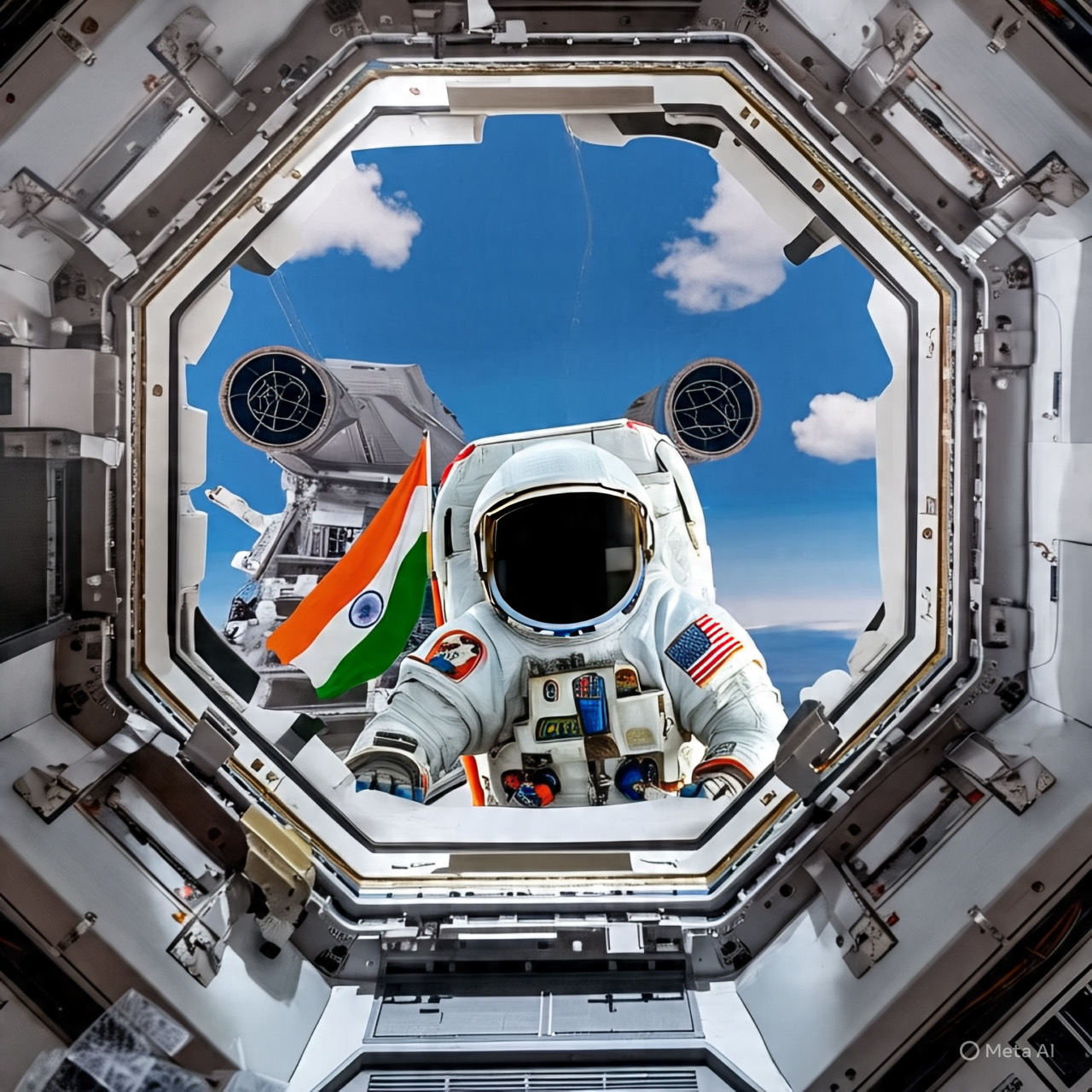
In a monumental stride for India’s space aspirations, Group Captain Shubhanshu Shukla of the Indian Air Force is set to etch his name in history as the first Indian astronaut to journey to the International Space Station (ISS). His participation in Axiom Space’s Axiom-4 (Ax-4) mission not only honors India’s pioneering legacy—tracing back to Rakesh Sharma’s 1984 spaceflight—but also marks a transformative leap in India’s ambitions for human space exploration.
From Fighter Pilot to Astronaut: A Journey of Purpose
Early Life and Education
Born on October 10, 1985, in Lucknow, Uttar Pradesh, Shubhanshu Shukla’s journey began at City Montessori School, renowned for nurturing academic excellence. Driven initially by civil service ambitions, his trajectory pivoted when he joined the National Defence Academy (NDA) in 2002. Commissioned into the Indian Air Force on June 17, 2006, Shukla swiftly distinguished himself as an aviator with unwavering dedication and precision.
Military Aviation Experience
Over his two-decade career in the IAF, Shukla has accumulated more than 2,000 flight hours on a wide range of frontline and support aircraft, including Su-30MKI, MiG-21, MiG-29, Jaguar, Hawk, Dornier, and An-32. This diverse exposure reflects not only operational versatility but also deep tactical acumen—key for any space-bound aviator entrusted with mission-critical responsibilities.
Academic Expertise
Pursuing excellence beyond the skies, Shukla earned an M.Tech in Aerospace Engineering from the prestigious Indian Institute of Science (IISc), Bengaluru. His strong academic foundation enables him to engage with complex spacecraft systems, conduct onboard research, and understand spaceflight dynamics from an engineering perspective—capabilities crucial for the Ax-4 mission and beyond.
Training the Astronaut: Preparing for Space
Selection for Human Spaceflight
In 2019, Shukla was selected among four elite IAF officers to train for ISRO’s Gaganyaan mission—India’s indigenous human spaceflight program. His training began at the Yuri Gagarin Cosmonaut Training Center in Russia, encompassing rigorous simulations and survival drills, and continued at ISRO’s Astronaut Training Facility in Bengaluru, sharpening his readiness for the microgravity environment.
International Collaboration for Ax‑4
The Ax‑4 mission required further specialized training, including modules conducted by NASA, the European Space Agency (ESA), and the Japanese Aerospace Exploration Agency (JAXA). Shukla trained in areas such as spacecraft systems, emergency response protocols, ISS research modules like ESA’s Columbus and JAXA’s Kibo, and experiment execution—ensuring seamless integration into an international crew.
Mission Profile: Axiom‑4 and Global Partnership
Crew Composition
The Ax‑4 crew represents a milestone in multinational collaboration:
- Commander: Peggy Whitson (USA) – Former NASA astronaut and veteran of three ISS missions
- Pilot: Group Captain Shubhanshu Shukla (India)
- Mission Specialists: Sławosz Uznański (Poland) and Tibor Kapu (Hungary) – Representing their nations’ first human flights to the ISS
Launch Timeline
Originally scheduled for June 10, 2025, the launch was postponed due to weather and is now set for June 11, 2025, at 5:30 PM IST. The crew will travel aboard SpaceX’s Falcon 9 rocket and Crew Dragon capsule from Kennedy Space Center, Florida. Docking with the ISS is expected approximately 28 hours after liftoff.
Duration and Objectives
The Ax-4 mission will span about 14 days aboard the ISS, during which the crew will carry out around 60 scientific experiments. Of these, 7 core experiments have been designated to Shukla, covering key research areas that reflect India’s scientific priorities.
Scientific Contributions: India’s Role in Space Research
Microgravity and Material Sciences
Shukla will conduct studies examining how materials behave in microgravity, focusing on 3D printing, polymer science, and composite development. These insights can revolutionize space manufacturing and may lead to the development of stronger, lighter materials for use both in orbit and on Earth.
Biomedical and Life Sciences
Biomedical research under Shukla’s charge includes:
- Evaluating cardiovascular responses to fluid redistribution in space
- Testing continuous glucose monitors for managing diabetes in microgravity
- Monitoring neuro-ocular changes such as Spaceflight Associated Neuro-Ocular Syndrome (SANS)
These studies can significantly enhance medical preparedness for astronauts, while also supporting inclusive selection criteria in future missions.
Health Monitoring and Innovations
For the first time, insulin delivery and glucose monitoring devices will be tested in orbit by an Indian astronaut—paving the way for accommodating individuals with chronic conditions in long-term missions. These developments could eventually democratize space access.
Physiological Challenges of Spaceflight
During his stay aboard the ISS, Shukla will experience:
- Space Motion Sickness: Temporary nausea and disorientation
- Fluid Redistribution: Leading to facial puffiness and cardiovascular adjustments
- Bone and Muscle Loss: Due to lack of gravity, requiring post-mission rehabilitation
- Neuro-Ocular Syndrome (SANS): Vision-related changes from fluid shifts
- Cardiovascular Deconditioning: Reduced heart workload and aerobic capacity
His real-time health monitoring will not only ensure mission success but also feed into future space habitation models.
A National Moment of Pride and Unity
India Reacts
Group Captain Shukla’s selection has resonated deeply with the Indian public and scientific community. Esteemed astronomers have hailed him as an emblem of India’s growing prowess, while the Indian Air Force and ISRO jointly issued commendations, terming the event a historic step in Indian aerospace excellence.
Family and Public Sentiment
In Lucknow, Shukla’s family stands proud yet understandably anxious. His parents and sister recently hosted Israeli astronaut Eytan Stibbe, who offered encouragement and insight from his own Axiom mission. Their emotional strength reflects the faith of a nation standing firmly behind one of its bravest sons.
Looking Ahead: Gaganyaan, Antariksh Station & Lunar Goals
The Ax-4 mission is more than an end—it is a launchpad for India’s future:
- Gaganyaan Mission: Scheduled for 2027, it will be India’s first fully indigenous crewed mission
- Bharatiya Antariksh Station: Targeted for completion by 2035, it will symbolize India’s space independence
- Lunar Landing Goal: India aims to land astronauts on the Moon by 2040
This progressive roadmap is backed by strong government support and strategic international collaboration, with Ax-4 serving as a critical validation of India’s human spaceflight capabilities.
The Axiom‑4 Mission Timeline
| Date | Event |
|---|---|
| June 10, 2025 | Launch postponed due to weather |
| June 11, 2025 | Launch at 5:30 PM IST from Kennedy Space Center |
| June 12, 2025 | Docking with ISS after ~28-hour transit |
| June 12–25, 2025 | 14-day mission duration, ~60 experiments including 7 by Shukla |
| June 25, 2025 | Undocking and return to Earth via Crew Dragon capsule |
Conclusion: India Rises Among the Stars
Group Captain Shubhanshu Shukla’s impending mission is not just a career milestone—it is a defining event for India’s ascent as a spacefaring nation. From elite military pilot to globally trained astronaut, his journey reflects a synergy of science, defense, and international cooperation.
His mission stands for:
- Technological advancement in manned spaceflight
- The blending of military discipline with scientific innovation
- A bold step toward inclusive and sustainable space exploration
- A signal to the world that India is ready to lead in the cosmos
As Shukla lifts off toward the ISS, he carries the collective dreams of 1.4 billion Indians. His voyage is a spark—illuminating the skies not only with rocket fire but with the enduring flame of national ambition.