









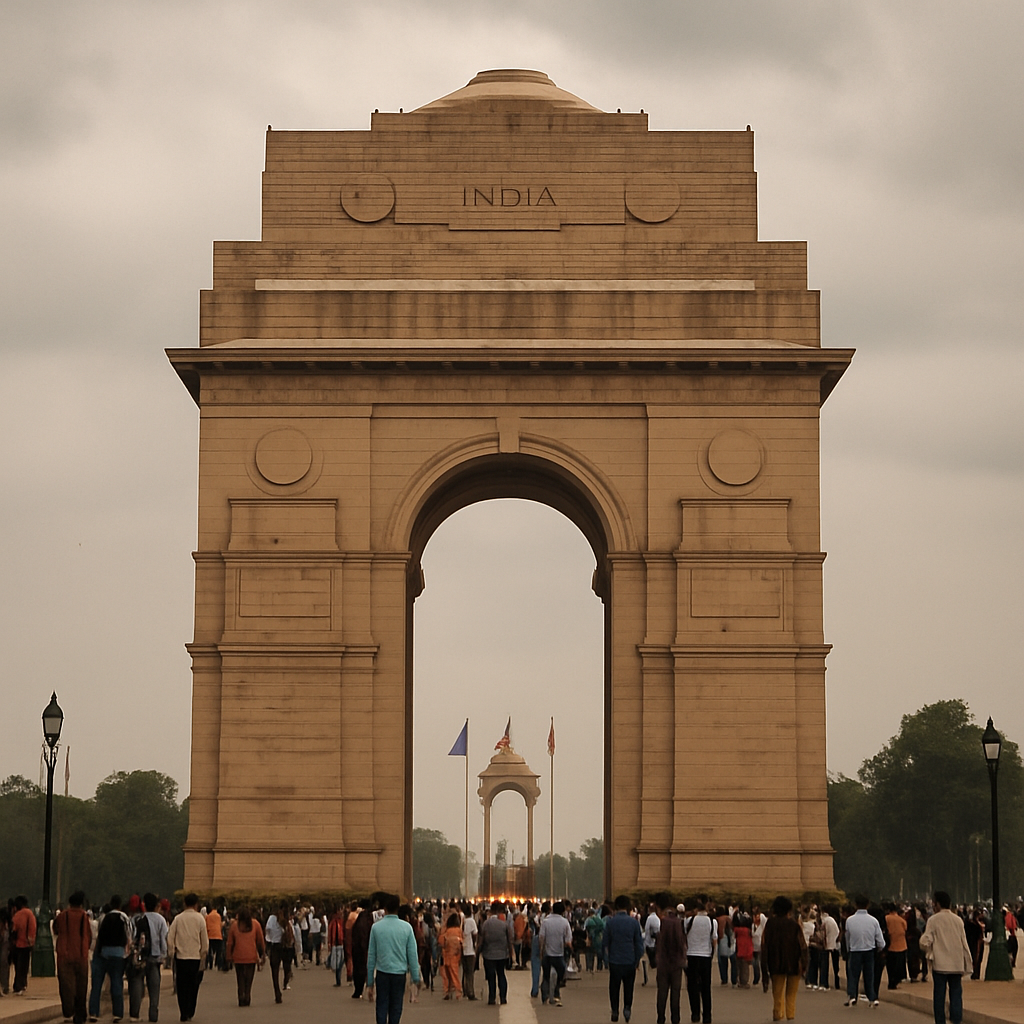
Towering gracefully over the heart of India’s capital city, India Gate remains one of the country’s most enduring and iconic landmarks. With its majestic architecture and powerful symbolism, this monument has served for nearly a century as a tribute to India’s soldiers, a hub for patriotic events, and a gathering point for people from all walks of life. Yet today, India Gate is also witnessing modern challenges—from evolving cultural sentiments to security pressures and urban transformations. These layers of meaning and activity make India Gate a living monument—both revered and contested.
A Monument of Memory: Historical Significance
Constructed in 1931 and designed by Sir Edwin Lutyens, India Gate was initially known as the All India War Memorial. The 42-meter-high arch was built to honor the memory of over 70,000 Indian soldiers who lost their lives during World War I while fighting for the British Indian Army.
Names of more than 13,000 servicemen, including soldiers and officers, are inscribed on the surface of the arch. Following India’s independence, India Gate evolved from a colonial war memorial into a national monument. In 1971, the Amar Jawan Jyoti (Flame of the Immortal Soldier) was added beneath its arch to commemorate the Indian soldiers who died during the Indo-Pakistani War of 1971. For decades, this eternal flame served as a central symbol of valor, visited by dignitaries and the public alike.
Even after the shift of the Amar Jawan Jyoti to the National War Memorial in 2019, the memory and symbolism of India Gate remain deeply entrenched in India’s collective consciousness.
Recent Developments at India Gate: An Evolving Space
1. Heightened Security and Surveillance
Amid increasing security concerns, particularly regarding cross-border tensions and threats of urban terrorism, India Gate has seen a significant ramp-up in protective measures. Law enforcement authorities have periodically conducted large-scale drills and implemented drone surveillance systems in and around the area.
Security threats, although often unconfirmed, have led to precautionary evacuations and restricted public access during peak hours or major events. These steps underline how this public monument has become intertwined with national security strategies, especially given its proximity to key government buildings and military memorials.
2. Branding and Legal Battles Over “India Gate”
India Gate’s iconic status has made its name synonymous with national pride. This has led to fierce trademark disputes in the commercial sector. A well-known rice brand using the “India Gate” label has fought legal battles to protect its brand identity against similar names in the market. Such cases reveal how the monument’s symbolic capital extends far beyond tourism and heritage—it now holds immense value in commerce and cultural representation.
The judiciary has consistently reinforced the uniqueness and recognizability of “India Gate,” emphasizing its close association with India’s national identity. This legal recognition strengthens its standing not only as a monument but as a cultural trademark.
3. Calls for Renaming Stir Controversy
A recent proposal to rename India Gate as “Bharat Mata Dwar” triggered a nationwide debate. Advocates of the name change argued that the colonial origin of the monument should be replaced with an identity that reflects post-independence Indian ethos. They called for a name that would honor Bharat Mata (Mother India) rather than a memorial initially dedicated to Indian soldiers who fought for the British.
However, this suggestion sparked a wave of public reactions, ranging from strong approval among some nationalist groups to equally passionate opposition from historians, heritage lovers, and civil society members. Critics warned that such a renaming could erode historical continuity and blur the complex legacy of India’s struggle and sacrifice during colonial times.
For many citizens, India Gate stands as a fusion of remembrance and nationalism. It is seen as a testament to the sacrifices made by Indians, regardless of the context in which they fought. Changing its name, therefore, risks unraveling the layered meanings it has come to embody over the decades.
Cultural Symbolism and Public Sentiment
Despite bureaucratic debates and political proposals, India Gate continues to be one of the most beloved and accessible public spaces in the capital. The lawns that stretch on either side of the structure, the expansive Rajpath (now known as Kartavya Path), and the proximity to Rashtrapati Bhavan make it a magnet for locals and tourists alike.
Following extensive renovation efforts, the India Gate complex has become even more people-friendly. The government improved pedestrian walkways, lighting, and aesthetic landscaping, while adding recreational and cultural amenities around the site.
The results were immediate. People from all backgrounds—from local families and evening joggers to tourists and street vendors—returned in large numbers. The monument and its surroundings once again became a site for informal recreation and civic pride.
Moreover, India Gate continues to serve as a powerful backdrop for candlelight vigils, peaceful protests, student movements, and national celebrations. This multi-purpose use reflects its transformation from a colonial war memorial into a vibrant democratic space.
Cinema and India Gate: Reel to Real Impact
India Gate’s visual majesty and symbolic power have not gone unnoticed by filmmakers and cultural creators. A pivotal film portrayal in the early 2000s played a major role in cementing India Gate’s image in the popular imagination as a site for civil action. In the film, a group of youth gather at the monument to protest government injustice—an image that was soon replicated in real-life movements, including anti-corruption and gender justice campaigns.
This cinematic portrayal blurred the lines between art and activism. Since then, India Gate has emerged not just as a tourist spot, but as a venue for youth-driven change, cultural statements, and moments of national reflection.
Today, visitors to India Gate often carry candles, placards, or flags—reflecting both reverence and resistance. The monument continues to provide a platform where democracy meets memory.
India Gate and Urban Planning: A Balancing Act
As Delhi’s urban sprawl grows and modernization accelerates, balancing conservation with development remains a challenge. Urban planners face the complex task of managing the India Gate zone without disrupting its historical sanctity.
Efforts are underway to restrict vehicular access during certain hours to minimize pollution and ensure pedestrian safety. There’s also growing interest in introducing electric mobility carts, guided heritage tours, and eco-conscious landscaping to reduce the monument’s environmental footprint.
Such changes aim to enhance public access while maintaining the dignity of the monument. The goal is to ensure that India Gate remains not just a structure frozen in time, but one that continues to evolve in harmony with its urban surroundings.
India Gate in the Age of Social Media
In the digital age, India Gate is also one of the most photographed locations in India. Social media platforms are flooded daily with images of the monument at sunrise, sunset, and under night lights. Its grandeur and historical appeal make it a natural favorite for Instagrammers and vloggers.
This digital visibility adds to its cultural footprint. Heritage campaigns and tourism promotions often leverage India Gate as their visual mascot. Even civic awareness programs use its backdrop for conveying messages of national unity, cleanliness, or environmental responsibility.
While this enhances public engagement, it also brings concerns over crowd management, littering, and unsupervised gatherings. Authorities continue to issue public advisories to maintain cleanliness and discipline around the premises.
India Gate: The Road Ahead
India Gate’s future lies in embracing its layered identity. It is simultaneously a colonial-era war memorial, a symbol of Indian patriotism, a modern civic space, and a commercial brand.
Preserving its legacy while allowing it to adapt to present-day needs is both a privilege and a challenge. Policymakers, historians, city planners, and citizens must work together to protect its sanctity without making it exclusionary or over-regulated.
In a nation of more than 1.4 billion people, monuments like India Gate play a vital role in unifying diverse experiences into a shared narrative. Its enduring relevance proves that heritage, when actively engaged with, can be both timeless and timely.
Final Thoughts
India Gate is more than just a monument built of sandstone; it is an evolving chronicle of India’s sacrifices, aspirations, and ongoing journey. From solemn remembrances to spirited gatherings, from political debates to joyful celebrations—it holds space for all.
As India continues to chart its path in the 21st century, India Gate will undoubtedly remain a beacon of unity, dignity, and democracy.