









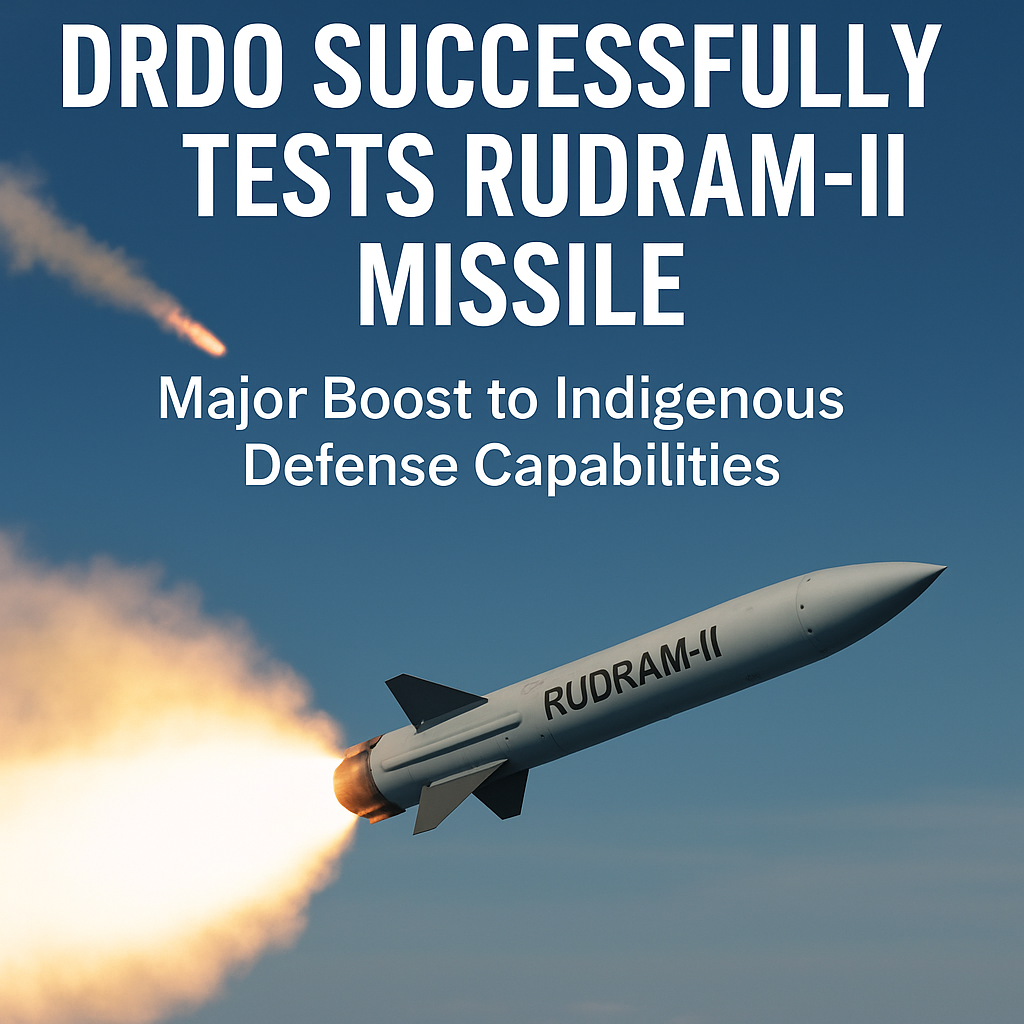
India has achieved a significant milestone in strengthening its indigenous defense arsenal with the successful test flight of the RudraM-II air-to-surface missile. Designed and developed as part of the country’s advanced weapons program, this latest trial showcased the missile’s reliability, precision, and high performance, solidifying its position as a force multiplier for the Indian Armed Forces.
Test Overview and Performance
The missile was launched from a Su-30MKI fighter aircraft over a designated testing range in the Bay of Bengal. The test aimed to validate multiple mission parameters, including the weapon’s propulsion system, control algorithms, and guidance mechanisms.
The launch vehicle, a frontline air superiority fighter, was outfitted with a specialized interface for the RudraM-II. The missile executed a flawless trajectory, maneuvering through its designated flight path before striking its intended target. Data from radar tracking systems, electro-optical sensors, and telemetry stations confirmed the missile’s precise navigation and impact accuracy.
The test also evaluated the missile’s ability to lock on to targets either before or after launch, depending on operational requirements. Such flexibility adds a critical advantage in combat scenarios where real-time adjustments are needed.
Design and Capabilities
The RudraM-II missile is an advanced air-to-surface weapon system engineered to engage enemy radar installations, air defense systems, and fortified ground targets. It incorporates several next-generation features designed to optimize lethality and survivability in high-threat environments.
It uses a dual-pulse solid propulsion system, allowing it to sustain velocity and trajectory adjustments in mid-air. This two-phase propulsion also enables the missile to execute high-G maneuvers and hit evasive or mobile targets.
Capable of reaching speeds of up to Mach 5.5, the missile delivers rapid strike capabilities while minimizing the risk of interception. With an operational range extending to 300 kilometers, it offers standoff engagement capabilities, allowing fighter aircraft to remain outside enemy air defense envelopes.
The missile features an advanced seeker system, available in two configurations. One variant is equipped with a passive homing head designed to detect and destroy radar emitters, effectively disabling enemy surveillance and targeting systems. The other variant is outfitted with an imaging infrared seeker for precision targeting of static installations like airstrips, ammunition depots, and command centers.
These seekers provide both Lock-On-Before-Launch (LOBL) and Lock-On-After-Launch (LOAL) functionalities, significantly increasing operational flexibility and survivability for the launch platform.
Operational Integration
Initially configured for launch from the Su-30MKI, the RudraM-II is being developed for integration with other frontline fighter jets, including the Mirage-2000 and future indigenous platforms. The missile’s modular design allows for easier adaptation to various airframes.
The successful test paves the way for deployment planning and full-scale production. Integration efforts are being supported by various agencies involved in aircraft modification and weapons testing. These efforts include not only hardware integration but also extensive simulations, pilot training modules, and mission planning support systems.
Developmental Timeline
The missile’s development began in the early 2010s as part of a strategic program aimed at building a family of air-launched weapons capable of penetrating modern air defense systems. Following initial design studies and wind tunnel tests, the project entered the development phase, which included extensive lab simulations and sub-system validations.
Flight release trials commenced several years ago using prototype airframes. These tests focused on validating flight stability, control surface responses, and aerodynamics. Subsequent stages involved seeker calibration, warhead integration, and telemetry instrumentation.
Earlier tests included separation trials to ensure safe and stable release from the carrier aircraft under various flight conditions. After successful anti-radiation test flights, the RudraM-II was cleared for final performance validation, culminating in the latest live-fire test.
The current iteration reflects multiple design optimizations based on earlier test data, including improvements to the missile’s propulsion efficiency, guidance stability, and target acquisition accuracy.
Strategic Impact
The RudraM-II significantly enhances the offensive capabilities of India’s air forces. With its ability to neutralize critical enemy infrastructure from long distances, it reduces the need for close-in aerial confrontations and minimizes exposure to hostile environments.
In a conflict scenario, the missile can be used in the early stages of an air campaign to degrade enemy air defenses, paving the way for safer operations for follow-on aircraft. Its capability to target radar and surveillance systems is particularly useful in establishing air superiority.
The missile also serves a deterrence role, sending a strong message about the country’s technological progress and readiness to engage in high-precision warfare. The ability to develop and deploy such systems indigenously enhances national security and strategic autonomy.
Technical Highlights
-
Propulsion: Solid-fueled dual-pulse motor for extended range and maneuverability.
-
Speed: Hypersonic speed up to Mach 5.5, enabling quick strike and limited reaction time for adversaries.
-
Range: Effective operational range of up to 300 kilometers, allowing standoff targeting.
-
Seeker Systems: Dual options – Passive Homing Head for anti-radiation missions and Imaging Infrared for ground attack roles.
-
Launch Platforms: Designed for integration with Su-30MKI, Mirage-2000, and future indigenous aircraft like Tejas MkII.
-
Flight Control: Integrated navigation and inertial guidance with LOBL and LOAL capabilities.
Future Roadmap
Following the success of the RudraM-II, additional testing phases are scheduled, focusing on various mission profiles, environmental conditions, and platform integrations. Tests from other aircraft types are planned, expanding the missile’s operational footprint within the air force.
Upgrades to seeker sensitivity, data-link integration, and electronic counter-countermeasure (ECCM) features are also under development to enhance effectiveness in electronic warfare environments.
The RudraM series is set to expand with the upcoming RudraM-III, which aims to provide even greater range—up to 550 kilometers—and a larger warhead, with an emphasis on strategic and deep-penetration strikes.
Efforts are also underway to establish mass production lines through partnerships with defense production units and private-sector manufacturers, ensuring scalability and rapid induction into service.
Comparative Capabilities
When compared with contemporary systems used by other global military powers, the RudraM-II stands out due to its multi-role capability, modular seeker design, and hypersonic speed. Its flexibility allows it to bridge the gap between tactical and strategic air-to-ground operations.
Its design concept bears resemblance to international weapons such as the AGM-88E AARGM (used by the U.S.) and the Kh-31P (used by Russia). However, its indigenous origin offers distinct advantages in terms of cost, customization, and non-dependence on foreign suppliers.
Implications for Defense Industry
The RudraM-II’s development demonstrates the maturity of the domestic defense R&D ecosystem. It showcases capabilities in missile design, propulsion technology, guidance systems, and platform integration. The success of this missile will likely accelerate similar indigenous projects and foster further collaboration between public and private sectors.
Its production will generate demand across multiple sectors, including composite materials, avionics, telemetry systems, and explosives manufacturing, leading to broader industrial growth.
The missile also holds potential for export to friendly nations, subject to international regulations and strategic considerations. As a versatile and cost-effective solution, it could find interest among countries seeking to bolster their own air strike capabilities without dependence on global suppliers.
Conclusion
The successful test of the RudraM-II missile represents a critical achievement in India’s journey toward self-reliance in defense. It adds a powerful, precise, and flexible weapon system to the country’s air force inventory. Its advanced design, impressive range, and dual-mission functionality position it as a formidable asset in modern warfare.
As testing progresses and integration expands, the RudraM-II will play a pivotal role in shaping future combat doctrines and ensuring the strategic edge of Indian defense forces.